Oil’s $110 Warning: Can Hormuz Tensions Keep Prices Surging?
Crude prices retreat from a five-month high as traders weigh fresh Middle East threats against the prospect of more Russian oil supplies.
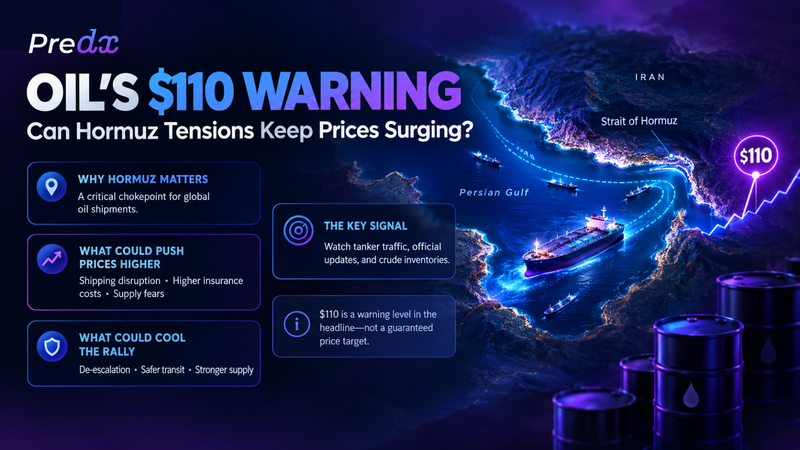

Oil markets are caught between two powerful forces: the fear of a supply shock and the hope that additional barrels will ease the pressure. On October 20, crude prices edged lower as investors assessed a possible U.S. relaxation of sanctions on Russian energy exports, even as tensions around the Strait of Hormuz continued to threaten global supply.
Brent crude had climbed to $110.70 per barrel on Monday, its highest level in five months, before pulling back. By Tuesday, Brent was down 0.45% at $109.06, while U.S. West Texas Intermediate (WTI) futures for November delivery slipped to $103.32. The retreat suggests traders are taking profits while waiting for clearer signals on supply and security.
The Strait of Hormuz: A Narrow Passage With Global Consequences
The Strait of Hormuz remains one of the world's most important energy chokepoints. Any disruption to tanker traffic can delay shipments, raise transportation and insurance costs, and intensify concerns about fuel shortages.
Those fears have become more immediate following reports of a tanker explosion after the vessel struck a naval mine in the strait. Iran's Revolutionary Guard confirmed the incident, while Iranian Foreign Minister Abbas Araqchi said Tehran's offer to reopen the waterway within seven days remained on the table.
For oil traders, the situation presents a difficult calculation. A diplomatic breakthrough could ease supply concerns and push prices lower. But further attacks or a prolonged disruption could quickly reverse that optimism.
The risk extends beyond crude prices. Higher energy costs can increase transportation expenses, put pressure on businesses, and complicate efforts to contain inflation worldwide. Reuters' regional market report details the continuing uncertainty.
Russia’s Oil Supply Could Change the Equation
While tensions in the Gulf threaten supply, Washington's potential easing of certain sanctions and tariffs on Russian energy exports offers a possible counterweight.
More Russian oil reaching global buyers could help ease shortages and limit price increases. However, the policy remains uncertain, and additional exports are not guaranteed. Russia's production has also remained below year-earlier levels, according to the International Energy Agency.
This leaves the market balancing two competing scenarios: a geopolitical shock that restricts oil shipments or a supply boost that helps offset those losses.
Neither outcome is certain—and that uncertainty is helping drive price swings.
Key Statistics to Watch
$110.70 per barrel — Brent crude's five-month high reached on October 19.
$109.06 per barrel — Brent crude price reported on October 20, down 0.45%.
$103.32 per barrel — November WTI futures price reported on October 20.
7 days — The timeframe Iran said it could use to reopen the Strait of Hormuz under its proposed conditions.
Source: Reuters, October 19–20, 2026. Prices and policy developments can change as new information emerges.
What Comes Next for Oil Prices?
Three developments could shape the next major move in crude:
Escalation in the Gulf: More attacks on tankers or energy infrastructure could revive fears of severe supply disruptions.
Progress toward reopening Hormuz: Safer passage and recovering shipments could ease the geopolitical premium built into oil prices.
Changes to Russian energy restrictions: A credible increase in Russian exports could soften supply concerns, although the timing and scale remain uncertain.
The key is to watch actual shipping activity, policy announcements, and confirmed supply data—not just headlines. Oil prices can fall even while geopolitical risks remain elevated, particularly when traders anticipate additional supply or lock in profits after a rally.
Final Remarks: Oil’s Next Move Could Hinge on One Major Signal
The oil market is not simply betting on war or peace. It is weighing how much crude can reach buyers, how much disruption the global economy can absorb, and whether new supplies can offset geopolitical threats.
For now, the pullback from $110 does not mean the danger has disappeared. It shows how quickly market expectations can change when supply prospects and geopolitical risks move in opposite directions.
Will oil prices climb again if Hormuz tensions intensify, or will additional Russian supplies bring relief?
Turn Breaking News Into Better Forecasts With PredX
Don't just follow the headlines—examine what they could mean for the next market move.
With PredX, explore prediction markets covering oil, geopolitics, economic developments, technology, and major world events. Follow changing expectations, research the signals, and compare different views of what might happen next.
The next big move may begin with today's headlines. Will you see it coming?
👉 Explore https://predx.pro/ and start forecasting the events shaping tomorrow's world.

Comments
No comments yet. Be the first to comment!