Goodbye, Microsoft Office? AI Developer Builds Free Word, Excel & PowerPoint Rivals
One developer, one AI assistant, and three ambitious open-source apps are challenging the way we think about paid software. But are they ready to replace the originals?
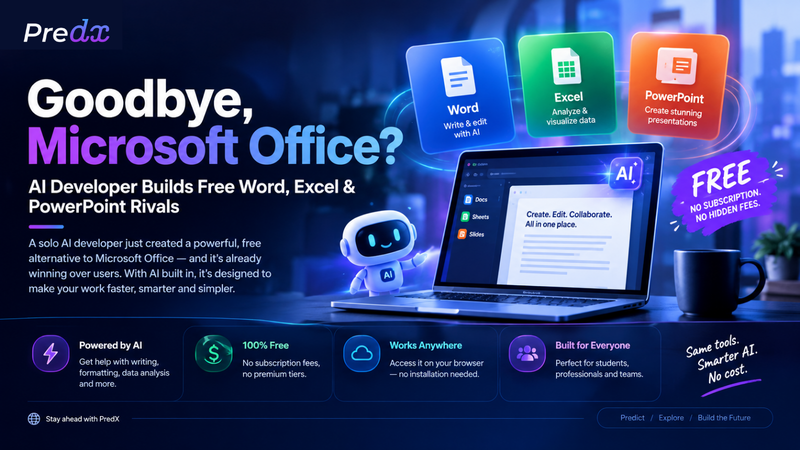

What if you could write documents, manage spreadsheets, and create presentations without paying for a Microsoft Office subscription?
Developer Brandon Thomas is exploring that possibility with three free, open-source applications built with help from Anthropic's Claude AI. The projects—WordCraft, GridCraft, and DeckCraft—aim to recreate the core experiences of Microsoft Word, Excel, and PowerPoint.
The release follows Thomas's earlier effort to build free alternatives to Adobe's creative software. Now, he's taking on another household name in productivity software, raising a bigger question: Could AI make expensive software easier to replicate than ever before?
Meet the Three Free Office Rivals
Thomas's projects are designed to feel familiar to people who already use Microsoft's productivity tools. They are written in Rust, a programming language known for performance, and aim to run across Windows, macOS, and Linux.
Here's what each application brings to the table:
WordCraft — The Word alternative: Designed for writing and document formatting, it supports DOCX files, tables, document styles, tracked changes, and other familiar features.
GridCraft — The Excel alternative: Built for spreadsheets, it offers hundreds of worksheet functions, charts, data tools, and support for XLSX files.
DeckCraft — The PowerPoint alternative: Focused on presentations, it supports slide layouts, images, charts, animations, and PPTX files.
Because the projects are open source, developers can inspect the code, contribute improvements, and adapt the software under its applicable licenses.
The goal isn't simply to copy the appearance of familiar apps. It's to recreate useful features while making the software accessible without a traditional subscription.
The Numbers Are Impressive—but There's a Catch
The projects have already made meaningful progress, particularly considering the role AI played in their development.
According to project figures reported by Decrypt, WordCraft covers approximately 88% of Word's ribbon features, while GridCraft supports 513 of Excel's 523 worksheet functions. DeckCraft has reportedly reached around 79% feature coverage compared with PowerPoint.
But feature counts don't tell the whole story.
A program might support hundreds of spreadsheet formulas and still struggle with a complicated business workbook. A document editor might open a Word file but fail to preserve its layout perfectly when saving it again.
The projects remain in early development, and their creators estimate that they are only around 50% to 60% ready for real-world work, depending on the application.
For students and curious users, they could be worth exploring. For businesses handling sensitive documents, financial reports, or important presentations, reliability and compatibility still matter more than impressive feature lists.
How AI Is Changing the Economics of Software
Traditionally, building a full productivity suite requires substantial engineering time, extensive testing, and years of ongoing development.
AI coding assistants are changing that equation. Tools such as Claude can help developers generate code, troubleshoot errors, implement features, and move from an idea to a working prototype more quickly.
That doesn't mean AI can automatically produce a polished replacement for every established product. Human judgment, testing, maintenance, and software design remain essential.
However, it does lower the barrier to experimentation. A small team—or even an individual developer—can now attempt projects that would once have demanded significantly more resources.
This creates a challenge for subscription-based software companies: when alternatives become easier to build, users may have more choices and stronger reasons to question what they're paying for.
Microsoft isn't the only company facing this shift. Thomas's earlier creative-software projects suggest that the same approach could extend to other categories of professional tools.
What This Means for the Future of Technology
The story is bigger than three free applications. It highlights a potential shift in the balance between established software companies and independent developers.
If AI-assisted development continues to improve, the competitive advantage of major software companies may depend increasingly on reliability, security, collaboration, customer support, and features that are difficult to reproduce—not simply on owning a familiar interface.
For consumers, that could mean more competition and new options. For developers, it could open the door to ambitious projects with smaller budgets.
Still, free software isn't automatically better software. Users should evaluate compatibility, security, updates, and stability before relying on early-stage tools for important work.
Final Remarks: Is AI About to Rewrite the Software Industry?
Brandon Thomas's Office-inspired projects are not yet complete replacements for Microsoft Word, Excel, or PowerPoint. But they demonstrate how AI is helping independent developers take on software categories that once seemed difficult to challenge.
The bigger question is no longer just whether AI can write code. It's how quickly that code can become reliable, useful software—and which industries will feel the impact next.
The next major technology shift could start with a developer challenging a giant.
🚀 Follow the Next Big Shift With PredX
From AI breakthroughs and tech industry battles to crypto trends and global events, the future is full of developments worth watching. PredX helps you explore prediction markets around the questions shaping tomorrow.
Will AI-powered tools disrupt the software giants? Which technology breakthrough could come next? Follow the developments, study the signals, and explore how market expectations evolve.
👉 Visit https://predx.pro/ and turn today's biggest headlines into tomorrow's informed forecasts. The future doesn't wait for anyone—start exploring what could happen next.

Comments
No comments yet. Be the first to comment!