AI Could Crack Crypto Before Quantum Computers — Is ‘Bunker Mode’ Next?
Ethereum researcher Justin Drake says the crypto industry may need to rethink wallet security as AI accelerates mathematical breakthroughs.
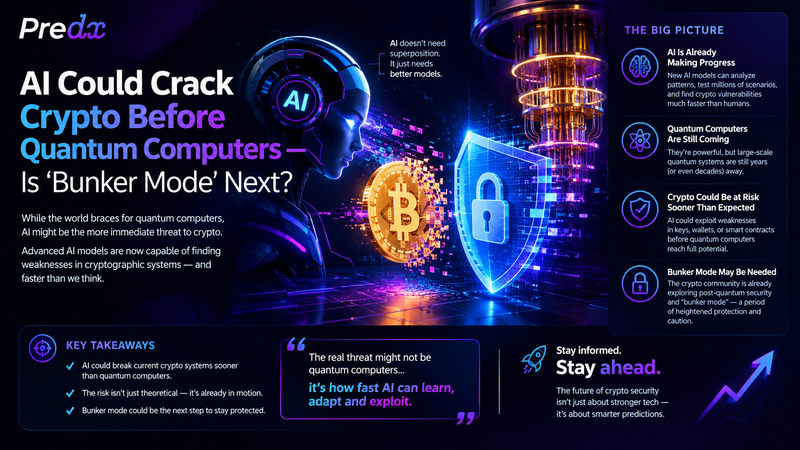

The biggest threat to crypto security may not arrive from a quantum computer after all.
Ethereum Foundation researcher Justin Drake is urging the blockchain industry to begin preparing for what he calls “bunker mode” — a defensive approach designed to limit exposure if advances in artificial intelligence eventually make it possible to break the cryptography protecting major crypto wallets.
Drake warned that the worst-case scenario could arrive “in months, not years,” arguing that AI-driven advances in mathematics could potentially uncover new ways to attack the Elliptic Curve Digital Signature Algorithm (ECDSA) used by Bitcoin and Ethereum.
That does not mean crypto wallets are being cracked today. No demonstrated attack has broken ECDSA, and Drake himself urged holders not to panic or rush into moving their assets.
Why AI Is Suddenly Part of the Security Debate
For years, the crypto industry has focused heavily on the threat of quantum computing — the anticipated point when sufficiently powerful quantum machines could undermine widely used public-key cryptography.
Drake now argues that rapidly improving AI could create a different path to the same problem.
His concern centers on the possibility that increasingly capable AI systems could discover previously unknown mathematical techniques capable of attacking elliptic-curve cryptography. He pointed to a recent wave of AI-generated mathematical results as a reason the industry should reconsider how quickly such breakthroughs could emerge.
If ECDSA were ever broken, an attacker could potentially derive a wallet's private key from an exposed public key and gain control of the assets secured by it.
That is the scenario Drake wants the industry to prepare for before it becomes an emergency.
The ‘Fresh Address’ Defense
Drake's recommendation is surprisingly straightforward: gradually move funds into fresh addresses whose public keys have not yet been exposed.
The logic is that certain wallet addresses keep the public key hidden behind a cryptographic hash until the address signs a transaction. Once a transaction exposes the public key, that address could theoretically become a more attractive target if a practical ECDSA-breaking technique emerges.
Drake therefore recommends a controlled migration, particularly for large and sophisticated holders, rather than waiting until a cryptographic emergency is already underway.
But there is an important caveat: he is not calling for a panic-driven mass exodus.
A rushed migration could create its own risks, including operational mistakes, phishing attacks, and transaction errors. Drake's message is essentially to prepare early — not to press the panic button.
The Bigger Question for Crypto
The debate goes beyond Bitcoin or Ethereum.
As blockchain adoption expands into exchanges, stablecoins, DeFi, institutional custody, and automated applications, cryptographic security becomes infrastructure for the entire digital-asset economy.
If AI eventually becomes capable of discovering fundamentally new attacks against established cryptographic systems, the industry may need more than new wallets. It could require new standards for signing transactions, rotating keys, and protecting long-term assets.
Drake has argued for accelerating Ethereum's move toward hash-based cryptography and other post-AI defenses, suggesting that the industry should start preparing before a theoretical vulnerability becomes a real-world crisis.
What Happens Next?
The key question isn't whether AI has already cracked crypto — it hasn't.
The real question is whether AI will advance quickly enough to challenge cryptographic assumptions that have protected billions of dollars in digital assets.
For crypto investors and market watchers, that makes this more than a technical debate. It is a developing story about AI, cybersecurity, blockchain infrastructure, and the future of digital ownership.
And when the technology changes faster than expectations, the ability to anticipate what comes next can matter just as much as reacting to what already happened.
🔮 Think Beyond the Headlines with PredX
The future belongs to those who see it coming. Follow the biggest developments across crypto, AI, technology, global events, and more — then turn your research and conviction into forecasts on PredX.
Don’t just watch what happens next. Start forecasting it.
🔗 https://predx.pro/news
This article is for informational purposes only and is not financial advice.

Comments
No comments yet. Be the first to comment!