New Zealand Election on a Knife’s Edge: Will Labour or National Secure the Path to Power?
With just nine days until New Zealand’s November 7 election, the polls are sending a clear message: the race is wide open, and the next government may depend on parties outside the traditional power struggle.
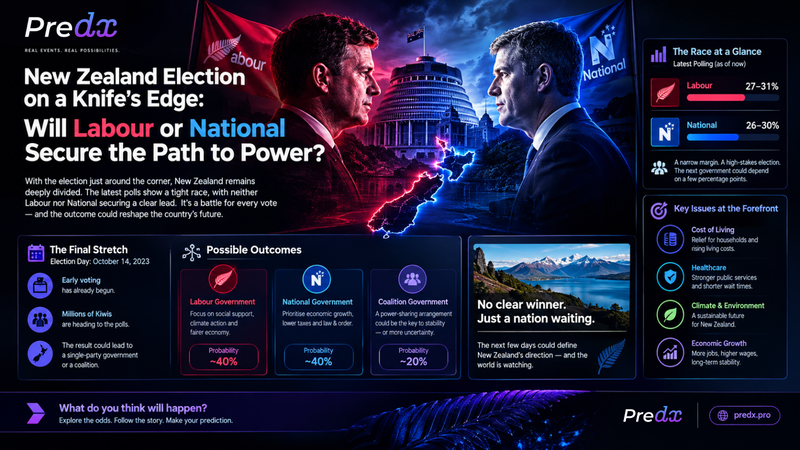

New Zealand’s election campaign has entered a decisive stretch, but voters still have no definitive answer to one critical question: who will govern the country next?
Fresh polling has revealed a volatile contest between Prime Minister Christopher Luxon’s National Party and the opposition Labour Party, led by Chris Hipkins. Yet the battle extends beyond the two major parties. Smaller political groups could ultimately determine which side secures enough parliamentary support to form the next government.
Polls Deliver Conflicting Signals
The latest surveys illustrate just how uncertain the election has become.
A Radio New Zealand–Reid Research poll released on October 29 placed Labour at 30.6%, while National dropped to 24.8%. Based on those figures, Labour could potentially form a government with support from the Greens and Opportunity.
However, a separate 1News–Verian poll published earlier in the week painted a different picture. National stood at 29%, potentially giving the party a route to another term alongside its existing coalition partners, ACT and New Zealand First.
The conflicting results highlight the difficulty of predicting the final outcome from any single survey. Polls represent snapshots of voter intentions, not guarantees of election-day results.
The Real Battle May Be Beyond the Ballot
New Zealand’s mixed-member proportional electoral system makes the contest more complicated than a simple comparison of party vote percentages.
Under this system, the distribution of parliamentary seats and the ability to assemble a governing majority matter just as much as which party finishes first. Smaller parties can become decisive partners when neither major political bloc commands enough seats to govern independently.
That puts parties such as ACT, New Zealand First, the Greens and Opportunity under intense scrutiny. Their final vote shares could determine whether Luxon’s coalition retains power or whether Hipkins can build an alternative governing arrangement.
The possibility of additional parliamentary seats through electorate victories adds another layer of uncertainty. As a result, even relatively small changes in polling could affect coalition calculations.
The biggest question may not be which party wins the most votes, but which combination of parties can secure enough parliamentary support to govern.
What Is Driving the Uncertainty?
The election comes as voters weigh economic pressures, the cost of living, housing affordability and the performance of the current government.
National is seeking another term, while Labour is attempting to convince voters that it offers a stronger alternative. Meanwhile, smaller parties have an opportunity to influence the policy agenda and potentially become essential partners in government formation.
Late-campaign developments, voter turnout and the decisions of undecided voters could all shift the balance before November 7.
For political observers, the next few days will be crucial. A party that appears to be gaining momentum may still struggle to form a government if its potential coalition partners fail to win enough seats.
The Prediction Market Question: Who Will Form New Zealand’s Next Government?
With competing polls producing different possible outcomes, New Zealand’s election presents a compelling case study in political uncertainty.
Prediction markets offer another way to examine these competing possibilities. Rather than relying exclusively on headlines or individual polls, participants can follow event-based questions and observe how market expectations change as new information emerges.
Key questions include whether National can retain power, whether Labour can assemble a viable coalition, and whether smaller parties will hold the balance of power.
Market prices can reflect how participants assess the likelihood of different outcomes at a given moment. However, they are not definitive forecasts, and they can change quickly as new polling, campaign developments and election information become available.
For anyone following the race, the contrast between polling numbers and coalition mathematics makes this election particularly worth watching.
The Final Countdown Has Begun
Nine days remain, and New Zealand’s political future is still uncertain. National may yet secure another term, Labour could find a path back to government, or smaller parties could become the deciding force in coalition negotiations.
The final result will depend not only on voter preferences but also on how those votes translate into parliamentary seats and governing partnerships.
One thing is clear: the closer election day gets, the more important every percentage point becomes.
Follow the Election Uncertainty With PredX
Don't just watch the headlines. Explore what could happen next.
PredX is a prediction-market platform where users can explore event-based questions, follow changing market expectations, and make predictions on outcomes that matter to them.
As New Zealand’s election approaches, follow the possibilities, examine the evolving outlook, and see how expectations shift as new information emerges.
The polls are divided. The outcome is uncertain. What do you think happens next?
Explore the possibilities and make your prediction on PredX: https://predx.pro/

Comments
No comments yet. Be the first to comment!