Hormuz Tensions Flare Again as Washington Tightens the Pressure on Tehran
Hormuz Tensions Flare Again as Washington Tightens the Pressure on Tehran
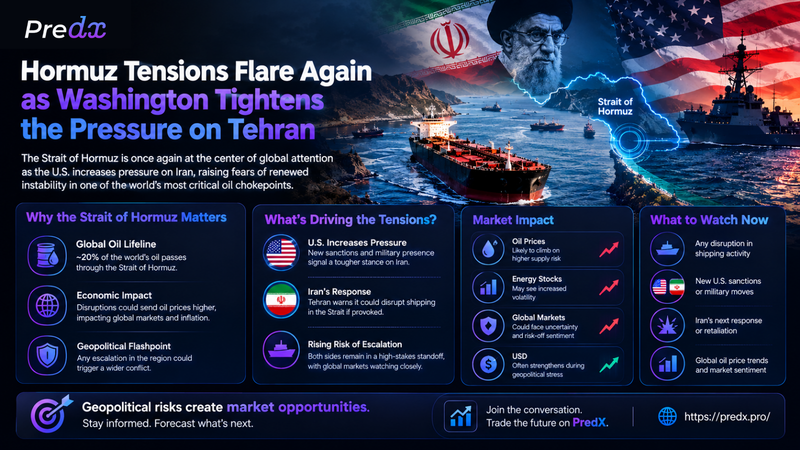

The fragile calm surrounding the Strait of Hormuz has once again given way to confrontation.
Iran has intensified its pressure around one of the world's most important energy corridors as the United States increases economic and military pressure on Tehran. The latest escalation is raising a familiar but increasingly urgent question: how far can both sides push the confrontation before the cost becomes too high to sustain?
The stakes extend far beyond Iran and the United States. The Strait of Hormuz is a critical route for global energy shipments, and disruptions have already contributed to sharply higher oil prices. Recent reports indicate that Gulf oil exports remain significantly below pre-conflict levels, while Brent crude has moved above $100 a barrel amid renewed fears over supply disruptions.
For businesses, governments and investors, the Strait is no longer simply a military flashpoint. It has become a daily indicator of how the conflict could affect the global economy.
A New Phase of Pressure
Washington's strategy has increasingly combined military pressure with economic measures designed to restrict Iran's ability to generate revenue and maintain leverage.
The U.S. has expanded efforts to limit Iranian oil exports while maintaining a significant naval presence around the Strait. American officials have also emphasized keeping the waterway open to commercial shipping.
Iran, meanwhile, continues to view control over Hormuz as one of its strongest strategic bargaining tools.
That dynamic has created a difficult balance. Tehran wants to demonstrate that it can disrupt or threaten shipping without necessarily triggering an uncontrollable regional war. Washington wants to prevent Iran from turning the waterway into an effective economic weapon while avoiding an escalation that could spread throughout the Middle East.
Recent attacks and counterattacks show how quickly that balance can deteriorate. Iran has claimed attacks against multiple vessels near the Strait following U.S. strikes on Iranian oil tankers, while Washington has said its actions were responses to Iranian attacks against U.S. military assets.
The result is a cycle in which every military move can create another economic consequence.
Why the Strait Matters So Much
The importance of Hormuz is difficult to overstate.
The waterway connects the Persian Gulf with the Gulf of Oman and the wider global shipping network. A prolonged disruption can affect crude oil, refined products, shipping costs, and inflation far beyond the region.
Recent data suggests that Gulf oil exports remain well below previous levels. Reuters reported that current exports are averaging roughly two-thirds of pre-war volumes, despite some ships continuing to move through the region using increasingly difficult and opaque routes.
That uncertainty is itself becoming a market risk.
Even when ships continue moving, questions about insurance, security, escorts, transit restrictions and potential attacks can increase the cost of transporting energy.
This creates an unusual situation: the market does not need Hormuz to completely close for the economic consequences to become significant.
A sustained reduction in traffic may be enough to keep prices elevated.
The Bigger Question: Pressure or Escalation?
The central issue now is whether Washington's pressure campaign can force Tehran toward negotiations or instead encourage Iran to take greater risks.
Iran is already dealing with severe economic pressure, including currency weakness, inflation, and reduced oil revenues. Reuters reported that the U.S.-led campaign has placed substantial strain on the Iranian economy, while analysts continue to debate whether that pressure will translate into political concessions.
That uncertainty makes the next stage particularly difficult to predict.
If Iran believes economic pressure is becoming unbearable, it could seek negotiations. But if Tehran concludes that maintaining pressure around Hormuz gives it greater bargaining power, the confrontation could continue.
Diplomatic channels remain possible, but previous attempts at reducing tensions have struggled to produce a durable settlement. Recent reporting indicates that disagreements over sanctions relief, shipping access and broader U.S. demands have complicated efforts to restore stability.
Prediction Markets Turn Uncertainty Into Measurable Questions
This is where prediction markets become particularly interesting.
Instead of asking a broad question such as “Will the Iran crisis get worse?”, prediction markets can break the situation into specific, measurable outcomes.
Will shipping traffic through Hormuz recover?
Will a diplomatic agreement be reached?
Will oil prices remain above a particular level?
Will tensions escalate before they ease?
These questions allow participants to express expectations around events that are unfolding in real time.
Existing prediction markets are already tracking specific Hormuz-related outcomes, including shipping traffic and the possibility of a U.S.-Iran agreement.
That makes the Strait of Hormuz more than a geopolitical headline. It becomes a live forecasting environment where new military developments, diplomatic statements, and shipping data can quickly change expectations.
Of course, prediction markets are not crystal balls. Their probabilities represent market expectations, not guaranteed outcomes. But they can provide another way to understand how people are interpreting rapidly changing information.
What Happens Next?
The most important signal may not be a single missile launch or diplomatic statement. It could be the direction of shipping traffic.
If commercial traffic gradually recovers, it could indicate that the immediate pressure around Hormuz is easing.
If traffic continues to decline, insurance and transportation costs rise, and attacks become more frequent, the economic consequences could deepen.
Oil prices will remain another critical indicator. Brent has already climbed above $100 as the conflict intensifies, demonstrating how quickly geopolitical risk can translate into financial pressure.
The bigger question is whether the current confrontation represents another temporary escalation or the beginning of a longer period of instability around one of the world's most important energy corridors.
For now, neither side appears ready to completely back down.
And that leaves the Strait of Hormuz at the center of a much larger question about what happens next.
Make Your Prediction With PredX
Geopolitical events rarely unfold exactly as expected. The advantage comes from watching the signals, understanding the possibilities and forming your own view before the outcome becomes obvious.
PredX brings that prediction mindset to real-world events, giving you a place to follow unfolding stories, explore possible outcomes, and make your own predictions.
The question isn't just what is happening.
It's what happens next.
👉 Make your prediction with PredX: https://predx.pro/

Comments
No comments yet. Be the first to comment!