Cruz Enters the 2028 Conversation as Republican Succession Race Takes Shape
The 2028 presidential race is still years away, but the Republican succession battle is already beginning to take form.
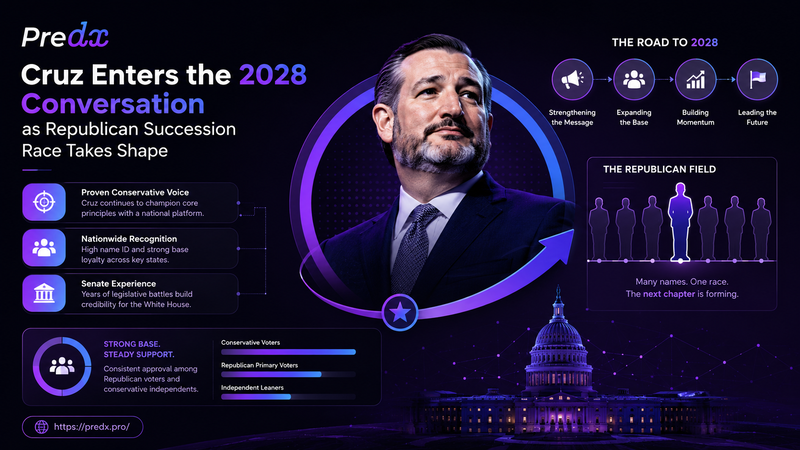

Sen. Ted Cruz of Texas is making increasingly visible moves that suggest he is keeping a presidential campaign firmly on the table. Cruz recently acknowledged that he wants to become president, while his appearances in Iowa and across conservative media have added fuel to speculation that he could once again seek the Republican nomination.
That ambition puts Cruz on a potential collision course with Vice President JD Vance, who is widely viewed as one of the strongest contenders to become the GOP's standard-bearer after President Donald Trump.
Cruz's approach, however, is not simply about announcing a candidacy. He appears to be testing the political environment—watching where the Republican Party is heading, identifying areas where he can distinguish himself, and challenging the assumption that Vance has already secured the inside track.
A Battle Over the GOP's Next Direction
Cruz and Vance represent overlapping but not identical visions of the Republican Party.
Vance has emerged as a central figure in the Trump-era GOP and has built a national profile as vice president. His potential path to 2028 has been strengthened by his proximity to Trump and his position at the center of the administration.
Cruz, meanwhile, brings a different political résumé. He ran for president in 2016, finished second to Trump in the Republican primary, and has remained a prominent conservative voice in the Senate.
His recent comments suggest he does not believe Republicans should treat the 2028 nomination as already decided.
Cruz has questioned whether the party should embrace a more isolationist approach to foreign policy and has also raised concerns about the direction of conservative economic policy. Those differences could become more important if the Republican primary eventually develops into a contest between competing versions of the post-Trump GOP.
Why Iowa Matters Already
Cruz's attention to Iowa is particularly significant.
The state has long played an important role in presidential politics, and Cruz's previous success there gives him an established political connection with Republican caucus voters. Both Cruz and Vance have made appearances in Iowa during the 2026 political cycle, officially with the midterms in focus—but their presence also inevitably feeds speculation about 2028.
For Cruz, the challenge is turning familiarity into momentum.
A potential campaign would have to demonstrate that he can expand beyond the coalition that supported him during the 2016 primary while remaining competitive in a Republican Party that has changed considerably since then.
Vance Isn't the Only Name in the Picture
The emerging Republican field is unlikely to be limited to Cruz and Vance.
Secretary of State Marco Rubio and other prominent Republicans are also being discussed as possible contenders. Trump himself has not definitively settled the succession question, adding another layer of uncertainty to a contest that has barely begun.
That uncertainty is precisely what makes the early 2028 political landscape interesting.
Instead of one clear successor, Republicans could eventually face a crowded contest involving candidates with different relationships to Trump's movement, different foreign-policy philosophies and different ideas about the party's future.
Where Prediction Markets Enter the Story
For observers, the question is no longer simply who says they might run?
The more interesting question is: who is actually gaining momentum?
That is where prediction markets can offer a different way to follow the 2028 conversation. Rather than relying solely on headlines, speeches, or early endorsements, market participants can continuously assess the likelihood of possible outcomes as new information emerges.
A Cruz appearance in Iowa, a major endorsement, a change in Trump's messaging, or a strong showing in early polling can all shift expectations.
And because the 2028 Republican field remains unsettled, there is plenty of room for those expectations to change.
The Cruz-Vance dynamic is therefore more than a developing political rivalry. It is an early signal that the Republican Party's next presidential contest could become a competition over both leadership and direction.
For now, Cruz is testing the waters, Vance remains a major figure in the succession conversation, and the rest of the Republican field is watching closely.
The race has not officially begun—but the signals are already starting to accumulate.
Track What Could Happen Next With PredX
Politics can change quickly, especially when a presidential field is still taking shape. PredX gives you a place to follow those possibilities through prediction markets and see how expectations develop as real-world events unfold.
Don't just wait for the next headline. Track the possibilities, explore different outcomes, and discover what people think could happen next with PredX.
Explore the predictions at https://predx.pro/

Comments
No comments yet. Be the first to comment!