Will Strait of Hormuz traffic normalize as oil markets price the US-Iran deal?
As Diplomatic Signals Improve, Traders Turn Their Attention to One of the World's Most Important Energy Routes
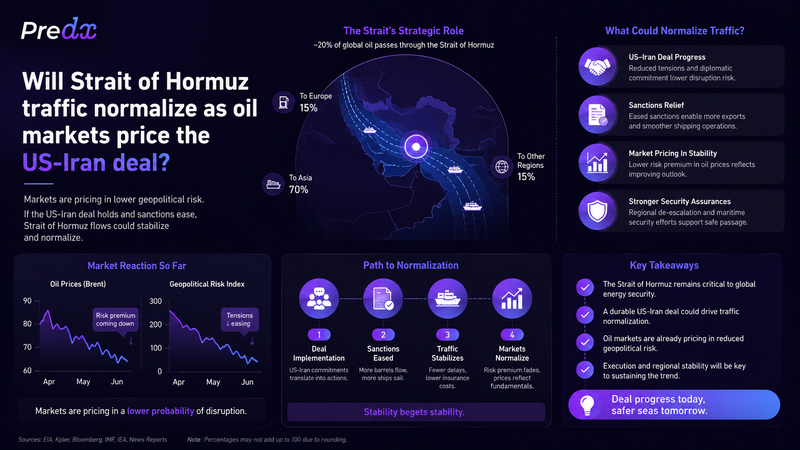

The Strait of Hormuz has long been one of the most closely watched maritime corridors in global commerce. Roughly a fifth of the world's oil supply passes through the narrow waterway, making every geopolitical development in the region a potential catalyst for energy prices and investor sentiment. Now, as speculation grows around a possible diplomatic breakthrough between the United States and Iran, prediction markets are increasingly asking one question: Will shipping through the Strait of Hormuz fully normalize?
Unlike traditional financial markets that often react after headlines emerge, prediction markets continuously reflect changing expectations. Every diplomatic statement, military development, or shift in sanctions policy can influence the collective probability assigned to a lasting agreement—and, by extension, safer shipping conditions across the Gulf.
Why the Strait of Hormuz Matters
The Strait of Hormuz connects the Persian Gulf to international waters, serving as a critical passage for crude oil and liquefied natural gas exports. Any disruption—whether from military tensions, vessel seizures, or heightened security concerns—can quickly ripple across global energy markets.
Shipping companies, insurers, commodity traders, and investors closely monitor developments because uncertainty often translates into higher transportation costs, increased insurance premiums, and greater oil price volatility.
If diplomatic negotiations between Washington and Tehran continue to gain momentum, markets may begin pricing in lower geopolitical risk. That could encourage shipping operators to restore regular routes while easing pressure on global energy supply chains.
Prediction Markets Become a Real-Time Confidence Gauge
Traditional analysis relies heavily on expert opinions and economic forecasts. Prediction markets offer another perspective by aggregating the expectations of thousands of participants who continuously update their positions as new information becomes available.
Rather than simply asking whether an agreement will be signed, participants evaluate broader outcomes:
Will shipping activity return to pre-crisis levels?
Will oil prices stabilize if tensions ease?
Could renewed negotiations reduce regional security risks over the coming months?
How sustainable would any diplomatic breakthrough actually be?
These evolving probabilities provide a real-time snapshot of market confidence rather than a single static forecast.
The Biggest Variables to Watch
Several factors could determine whether maritime traffic normalizes:
Diplomatic Progress: Formal agreements or renewed negotiations could improve confidence across energy markets.
Regional Security: Any unexpected military escalation could quickly reverse optimism and disrupt shipping.
Sanctions Policy: Changes in sanctions may reshape Iranian oil exports and influence tanker traffic throughout the region.
Commercial Confidence: Shipping firms and insurers often wait for sustained stability before fully restoring normal operations.
Because these developments can change rapidly, market expectations often shift long before official economic reports capture the trend.
Forecasting Geopolitical Events in a Changing World
The Strait of Hormuz represents more than an energy story—it highlights how geopolitics, global trade, and financial markets have become deeply interconnected. For analysts and observers, following these developments requires more than reacting to headlines; it means understanding how probabilities evolve as new information emerges.
Prediction markets have become an increasingly valuable tool for measuring collective expectations during periods of uncertainty, offering insights into how participants interpret unfolding global events.
Stay Ahead with PredX
Major geopolitical events can reshape markets in minutes. PredX gives you a smarter way to follow these shifts by allowing you to forecast real-world outcomes across global news, finance, sports, technology, entertainment, and more. Instead of simply watching events unfold, explore where informed expectations are moving and discover how collective market sentiment evolves in real time.
Join PredX today and turn every major event into an opportunity to forecast the future with confidence: https://predx.pro/

Comments
No comments yet. Be the first to comment!